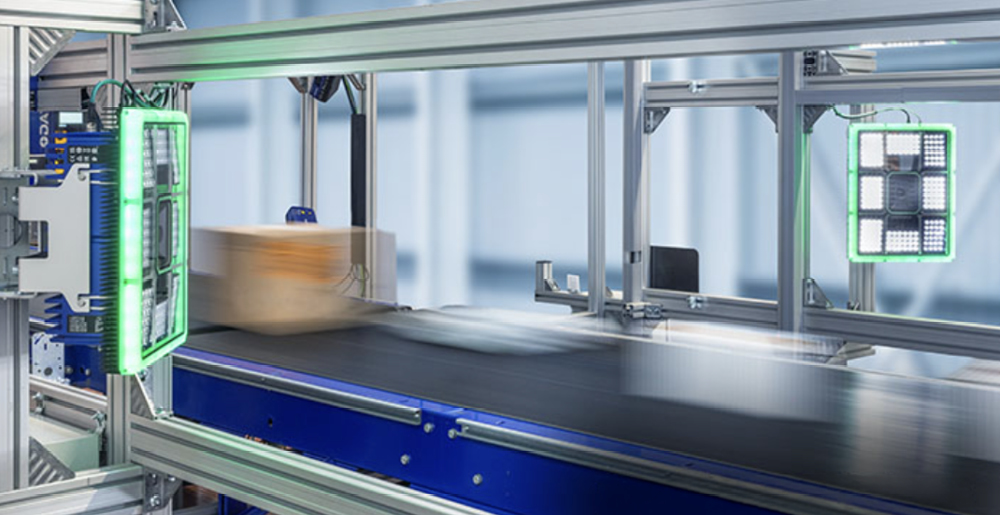
Barcode technology is evolving after decades of faithful service to the parcel sorting industry. Two-dimensional (2D) barcodes are steadily being implemented and are poised to eventually overtake the traditional one-dimensional (1D) barcode. Let’s look at how fulfilment centers, retailers and 3PLs can adapt and how the change will affect current automated parcel sorting system setups.
Traditional 1D barcodes use a series of parallel lines and spaces to encode information. Shipping labels also use this style of encoding to store tracking numbers and other shipment data. The 2D version uses a series of squares, dots, or other shapes arranged in a grid to store information in two dimensions. QR codes are a good example of this; however certain industries use formats such as Data Matrix and PDF417.
The essential benefit of 2D barcodes is their ability to capture multiple datapoints on one code. With 1D technology, multiple barcodes are often required to house SKUs, purchase order data, serial numbers and tracking numbers. With 2D, all this information can be stored using one code. This translates to better inventory visibility, more accurate tracking, and improved operational efficiency. Thes factors are the driving force behind the migration.
The new barcode format push is being led by Global Standards One (GS1), the global non-profit organization that manages barcodes worldwide.
GS1 has developed a milestone referred to as GS1 Sunrise 2027. Led by a coalition of the world’s leading retail brands, such as Amazon, Walmart and Target, the milestone dictates that stores implement hardware that can scan 2D labels by December 31, 2027.
Concurrently, these retailers, and many others, will begin mandating that sellers label packages and merchandise with 2D barcodes. This compliance will be enforced through supplier guidelines and shelf-agreements.
Because leading retailers are dictating the migration to 2D barcodes, operations that are part of the global supply chain of goods and materials will need to migrate along with them. As a result, product manufacturers that rely on this supply chain for components of their products, as well as ecommerce resellers, and 3PLs and fulfillment centers that process their packages, will also need to comply.
The ability to keep up with the change will require fulfilment centers, 3PLs and manufacturers to adapt new hardware that can effectively read the 2D barcodes. Most existing barcode readers in service are designed to read 1D labels. Parcel processing operations need to begin planning for implementation of the new technology.
For new systems, the technology can be incorporated directly into the design. ID Parcel & Mail Solutions is currently implementing a Datalogic Matrix 830/930-series 2D scanner into a new system that we are building for a global fulfilment company. This scanner can also read 1D barcodes. Both barcode types will likely be in service before the full migration is complete.
Our team likes the Datalogic 2D scanner for its high performance at a reasonable price point. The scanner features 16 megapixel high-resolution which is significantly higher than what standard barcode scanning requires. The 8000-pixel-wide sensor provides a considerably wide field of vision that is currently twice that of any other solution in its class.
These features are important when decoding very small, high-density data matrices, like those found on 2D barcodes, from varying distances and angles. The wide field of vision is also highly effective at capturing multiple 1D barcodes on a package. This is relevant as there will be a period where parcel fulfilment operations are processing both 1D and 2D barcodes.
For existing automated parcel sorting systems, new scanner hardware can likely be retrofitted. Because 2D imagers are built around the same mechanical and communication standards as existing 1D scanners, organizations can transition to the new barcode readers without a complete structural overhaul.
Depending on the system requirements upgrading may require additional steps such as updating software, modifying the label-generation process, or integrating new technology with existing equipment. For manual setups, 2D barcode reader hand scanners are available.
In the business of parcel automation, the technology, equipment, and business demands are constantly evolving. At ID Parcel & Mail Solutions, we build our systems to be flexible and modular. This industry change is a good example of the evolution of system requirements. As you begin to navigate the change to 2D barcode readers, our team can help you identify the right approach to fit your operation, budget, and future requirements.