Most fulfilment centers, ecommerce companies and manufacturers are aware of the fact that errors have consequences when processing parcels. Most, however, are not aware of the true financial costs. In addition to hurting the bottom line, shipping errors can also slow growth and ultimately erode consumer trust in a company. As more and more business leaders begin to see the full picture, they’re realizing the value of investing in automated parcel sorting systems.
Honeywell estimates that for a company shipping 1,500 orders a day, 260 business days a year, the cost of errors adds up to $195,000 annually. This is based on a conservative average of $50 per error. This calculation accounts for a conservative 1% error rate. Honeywell has estimated that fulfillment error costs can balloon as high as $250 per error depending on goods and processing costs.
There are a wide range of potential manual parcel sorting and processing errors that can occur during parcel fulfilment. Following are some of the most egregious.
Mis-sorts are one of the most operationally disruptive manual parcel fulfilment errors. This occurs when a package is placed in the wrong carrier lane, shipping zone, or destination container. Mis-sorts can lead to additional labor required to locate parcels, re-handling and sorting, expedited shipping to meet the committed delivery time, carrier penalties and customer service issue.
When a package is delivered to the wrong customer it causes a two-track recovery process. The first track requires managing both the customer that received the wrong package as well as the person who is missing their shipment. The second track is managing the inventory and re-shipment process. Just the idea of this likely send shivers down the spines of warehouse management and it’s costing them more than they likely know. If a lost shipment is not returned, the cost of replacing the product increases the cost of the error.
Industry data estimates the average cost to process a single mistaken return and fix the order is $15 to $25 per issue. This estimate accounts for return shipping, replacement shipping, and additional labor.
Organizations experiencing relatively frequent mis-sorts, incorrect shipping confirmations, or label reading errors that result in parcels being shipped to the wrong destination, often need to compensate for these errors. As a result, they may need to carry additional safety stock to avoid potential stockouts, and conduct more frequent inventory audits. These measures lead to cash flow pressure and additional labor.
Lost productivity can seem like an abstract concept, however the financial implications are very real and very costly. When a package is mis-sorted, misplaced, or incorrectly processed, employees must spend time locating the shipment, investigating the issue, processing the missorted shipment back into stock, re-routing the parcel, and updating documentation.
The biggest challenge with manual sorting is that even a small percentage of errors, when compared to the total quantity of parcels being processed, can add up significantly. Industry sources estimate that manual sorting accuracy hovers between 94-96%. This means 4-6% of parcels have error issues. Automated parcel sorting systems are estimated to perform, on average, above 99% accuracy. Several technologies make this possible.
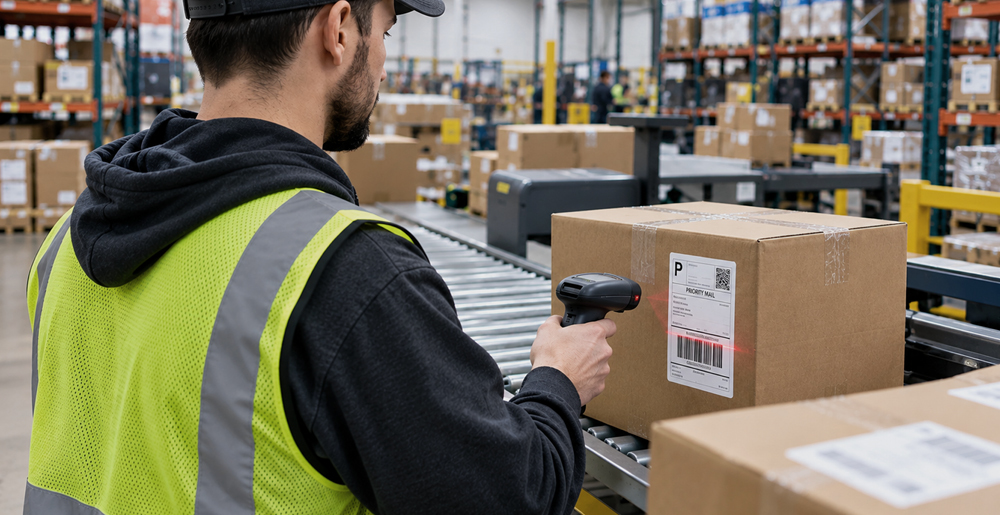
When workers are manually reading labels to route parcels it’s just a matter of time before an error occurs. Barcode scanners automatically capture label data. More advanced systems use multiple scanners positioned around the conveyor so the barcode can be captured regardless of the parcel's orientation.
Automated systems can also be set up with optical character recognition (OCR) that will read the address information in the event that the barcode is missing, damaged, obscured or unreadable in any way.
Once the barcode reader has identified the destination of the package, automated conveyors and sorters move them into their appropriate chute or bin. The consistency and accuracy of automated diverting technologies, not to mention the speed they provide, is an essential advantage of an automated parcel sorting system.
Automated parcel sorting systems can be outfitted with in-line weight scales and dimensioning units that capture each parcels weight and size as it moves through the line. This automation feature adds another layer of verification. Instead of relying on employees to estimate a package's size, pick the correct pre-sized box, or manually enter its weight (which leads to errors), automated systems capture these measurements with high accuracy.
The data that is captured can then be associated with the parcel's barcode and compared with predetermined shipment information. This helps identify discrepancies such as an incorrect weight, unexpected dimensions, or a package that exceeds the specifications for a particular processing stream.
Every fulfilment operation has different processing requirements. One thing they all share in common, however, is the inevitability of processing errors. ID Parcel and Mail Solutions works with companies that are just moving out of manual sorting, as well as larger companies that have automation solutions in place, but have specific sorting requirements. We tailor systems to each client’s specific needs to ensure the most effective return on investment. Reach out to our team to discuss your requirements.