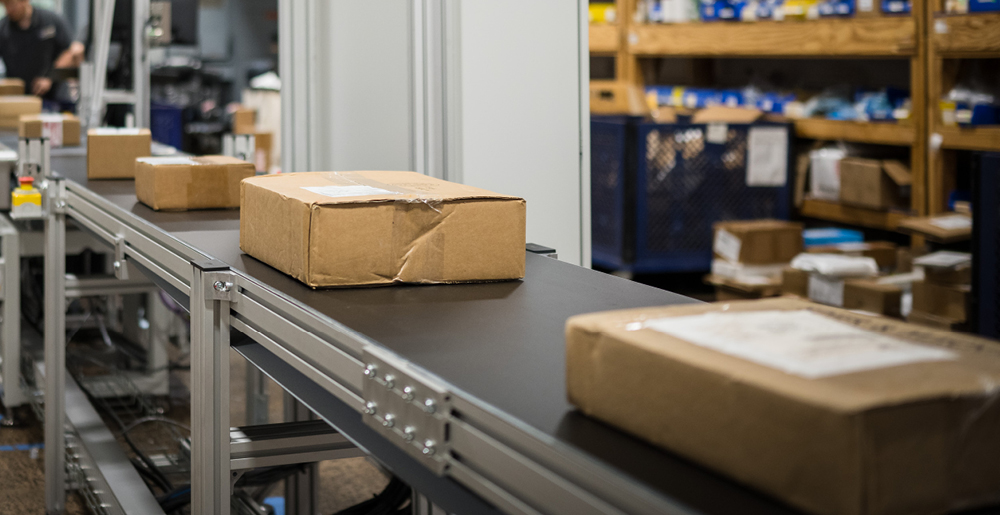
One of the biggest challenges fulfillment centers, 3PLs, and product manufacturers face during the holiday season is finding the most economical and efficient way to handle increased parcel throughput. For operations large and small, automated parcel sorting systems, such as ID Parcel & Mail Solutions’ Packet Parcel Sorting System (PPSS) will oftentimes pay for themselves, even if the equipment is only being used to its full capacity for part of the year.
For larger companies that are currently utilizing automated parcel sorting systems but do not have a system large enough to handle the additional holiday volume, investing in a smaller, supplementary system oftentimes makes financial sense.
For smaller operations that are manually processing packages, a new, relatively light system, like our smaller PPSS setup, can be utilized at its full capacity during the busy times and also remain useful for the remainder of the year. In these cases, although they may not provide maximum output all year, the economic and efficiency benefits can make them a smart investment. Here’s why:
Bringing on temporary staff can be a financial and operational burden in a variety of ways. Onboarding and training seasonal staff requires paperwork, system access setup, time to train and other steps that can take time away from management. Workflows often slow down or require simplification to accommodate a team with mixed experience. Seasonal employees typically have a higher rate of turnover. And errors are more common with less experienced workers.
Employing an automated parcel sorting system can greatly reduce or eliminate the need to hire seasonal staff. Seasonal workers require wages, overtime pay during peak surges, and sometimes incentives to attract the right talent. Automation removes most of these recurring peak-season labor expenses, reducing overall operating costs year after year.
Automated parcel sorting systems deliver consistent, predictable performance compared to that of humans. This is important year-round; however, it is particularly valuable when the parcel volume is extremely high and the pace of the operation is being pushed to its maximum.
Automation provides data that allows for more accurate forecasting and capacity planning. With reliable forecasts, teams can maintain consistent throughput, meet customer delivery expectations, and ensure carriers have the space and scheduling needed to move parcels on time. This is most critical during seasonal spikes.
When parcel volumes spike, workers can become overwhelmed. When this happens, errors become more likely. Humans have a tendency to mis-sort, mislabel, and mis-scan, especially under pressure or when rushed. Automating the process eliminates or greatly reduces these errors.
One of the main objectives of an automated parcel sorting systems is to process packages faster. Higher throughput is critical to successfully increasing capacity while creating a smoother, more predictable and cost-efficient workflow.
Faster processing also helps operations more successfully meet carrier cutoff times, which can be tighter during the holidays. Delaying the handoff of parcels to carriers can lead to late deliveries, customer dissatisfaction, and potential financial penalties tied to service failures.
All of these benefits culminate in a lower per-package cost during the most expensive time of year. When throughput is increased, labor and operational expenditures are reduced, and errors are avoided, costs go down and productivity goes up. Although it can be difficult to make the initial investment in an automated parcel sorting system, particularly for specific seasonal bumps, the ROI in this type of equipment can be significant. To start planning a system for next season, reach out to the team at ID Parcel & Mail Solutions to see if your operation would be a good fit for automation.